

Kuala Lumpur is the most underrated big city in Southeast Asia and the one where what you wear matters for practical reasons rather than fashionable ones, because the same day will take you through 33 degree equatorial humidity, a mosque with a dress code, and a shopping mall chilled to 19 degrees.
Disclosure: This post contains affiliate links. If you buy through them, Roman Trail earns a small commission at no extra cost to you.
The Malaysian capital of 1.8 million people in the city proper and roughly 8 million across the Klang Valley is a genuine three-culture city rather than a marketing claim. Malay, Chinese, and Indian communities have lived alongside each other here for generations, and the result is a place where a mosque, a Chinese clan temple, and a Hindu shrine can sit within a few streets of each other, and where the food is the best argument for visiting anywhere in the region.
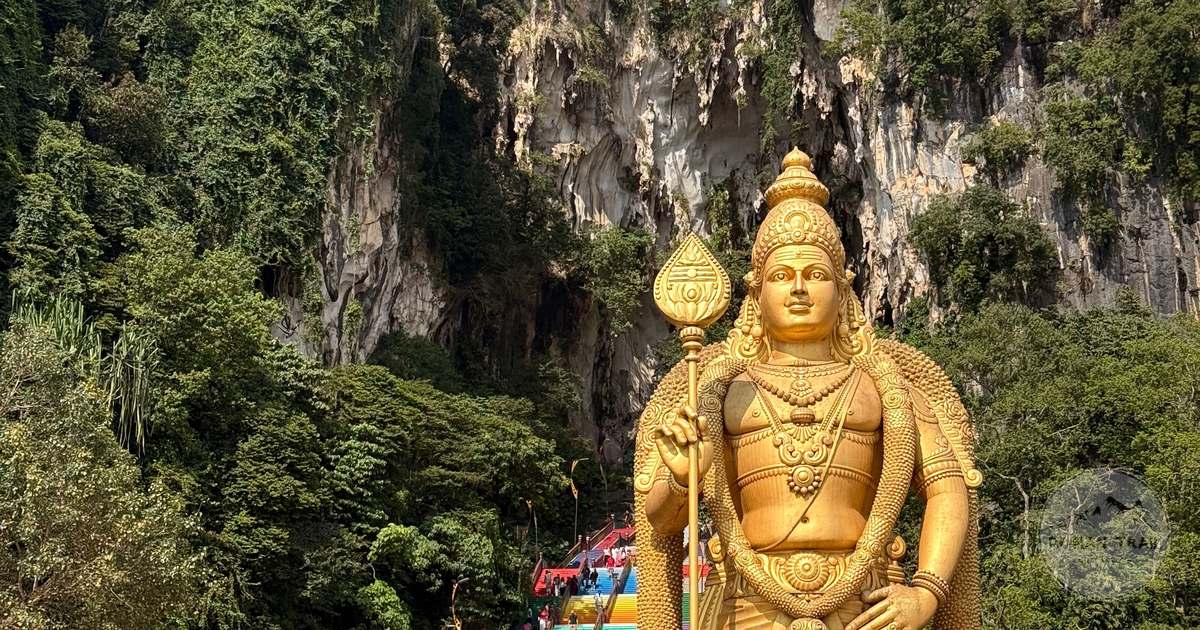
The Petronas Twin Towers were the tallest buildings in the world from 1998 to 2004 and remain the tallest twin towers anywhere, joined by a double-decker skybridge on the 41st and 42nd floors. Batu Caves, 13 kilometres north, is a limestone cave complex holding a Hindu temple, reached by 272 painted steps beneath a 43 metre golden statue of Lord Murugan. Merdeka Square is where the Malayan flag first rose in 1957. The Islamic Arts Museum holds the finest collection of Islamic decorative art in Southeast Asia and is the most underrated museum in the city. And Jalan Alor after dark is several hundred metres of open-air kitchens that constitute the best street food street in Malaysia.
What Makes Kuala Lumpur Different to Pack For
Three things, and none of them is simply heat.
The equator does not do seasons. Kuala Lumpur sits three degrees north of the equator, and the temperature is 31 to 34 degrees Celsius by day and 23 to 25 at night, every month of the year, with humidity between 75 and 90 percent. There is no cool season to wait for and no packing decision that changes between January and July. What does change is rainfall, and only in degree.
The air conditioning is genuinely aggressive. Malaysian malls, cinemas, offices, restaurants, and long-distance buses run cold, frequently below 20 degrees. Local women carry a cardigan or shawl year round for exactly this reason. Crossing from 34 degrees at 90 percent humidity into a 19 degree mall is a bigger shock to the system than anything the weather does, and you will do it several times a day.
Modest dress is required in places you will want to go. Malaysia is a Muslim-majority country, and while KL is relaxed and cosmopolitan in daily life, the mosques enforce a dress code: shoulders and knees covered, and a headscarf for women. The major mosques lend robes at the entrance, so you will not be turned away, but a borrowed polyester robe in that humidity is unpleasant, and dressing so you do not need one is the better plan. Hindu temples including Batu Caves also expect knees covered.
Recommended Tours and Experiences
Understanding Kuala Lumpur's Climate
Hot and humid, all year, with two wetter periods.
The wetter months run March through April and October through November, when the northeast and southwest monsoon transitions bring the heaviest rain. This is not a rainy season in the Southeast Asian sense of days of grey drizzle. It is sudden, intense afternoon and evening thunderstorms that drop a great deal of water in an hour and then stop.
The drier months, roughly June through August and January through February, still see rain, just less of it, and the humidity does not drop meaningfully.
The practical version: it rains hard somewhere in KL most afternoons in any month, it clears fast, and no month is a bad month to visit. Plan indoor activities for mid-afternoon and you have solved the weather.
One further note. The regional haze from agricultural burning in Sumatra and Borneo can affect KL air quality, most often between June and September. It varies year to year, and in a bad week the air quality index reaches levels where sensitive people should limit time outdoors. If you have asthma, check the reading before planning a long outdoor day.
The Packing List for Kuala Lumpur
Base Layer
The Roman Trail Women's Merino Wool Base Layer ($49-59) solves two Kuala Lumpur problems at once, which is why it earns space in a tropical bag where wool sounds like the wrong answer. At 160gsm it breathes and moves moisture away from the skin rather than trapping it, which is precisely where cotton fails at 90 percent humidity, and it does not develop odour after a sweaty day, so it survives several wears between laundry. It also covers your shoulders, which means you can walk into a mosque or Batu Caves without carrying a separate cover-up in the heat.
Bring two and rotate them. They wash in a sink and dry overnight under a fan.
Mid Layer
Counterintuitive in a tropical city and the item visitors most often leave at home. The Columbia Women's Fast Trek II Jacket ($65) is for the air conditioning rather than the weather: the malls, the cinemas, the long-distance buses, and any restaurant with glass doors. Something you can pull on in ten seconds and stuff in a bag is the whole requirement.
Rain Shell
The Marmot Women's PreCip Eco Rain Jacket ($110) handles the tropical downpours, which arrive fast and hard and flood the drains within minutes. Note that a waterproof shell in 90 percent humidity is a sweaty proposition, so the realistic pattern is to shelter for the twenty minutes it takes to pass and use the shell to get between buildings rather than to walk through a storm.
Sun and Insects
A wide brim sun hat with UPF 50 ($25) is worth carrying, because three degrees off the equator means the sun is close to directly overhead at midday and burns faster than the cloud cover suggests.
DEET insect repellent ($12) is not optional. Dengue fever is endemic in Malaysia and KL records cases every year. The Aedes mosquito that carries it bites during the day, particularly early morning and late afternoon, which is the opposite of the malaria pattern most travellers know. Repellent on exposed skin, applied over sunscreen, in the city as much as in the parks.
Footwear
The Salomon Women's X Ultra 4 GTX ($165) handles the 272 steps at Batu Caves, which are steep, uneven, wet in patches, and busy with macaques, plus the genuinely poor state of many KL pavements, which have open storm drains, missing slabs, and sudden level changes. Add sandals for everything else, since you will remove your shoes at mosque and temple entrances repeatedly and slip-ons make that painless.
For socks the Darn Tough Women's Hiker Micro Crew Merino Socks ($28) manage heat and moisture better than cotton on a long day of walking.
The Complete Clothing List
Two merino base layer tops. Two or three loose lightweight tops with sleeves. One pair of loose lightweight trousers or a long skirt for mosques and temples. One scarf or shawl, which doubles as a headscarf, an air conditioning layer, and sun cover, and is the single most useful item in a KL bag. One casual dress or smart outfit for the rooftop bars and the better restaurants, where KL dresses up more than the tropics suggest. Light cardigan or fleece. Compact rain shell. Walking shoes. Sandals. Swimsuit, since almost every KL hotel has a pool and you will use it. Three merino socks. Sun hat, sunscreen, insect repellent.
What to Wear at the Key Sites
Masjid Negara, the National Mosque, and Masjid Jamek. Shoulders and knees covered, headscarf required, shoes off. Both lend robes and scarves free at the entrance, and Masjid Negara has set visiting hours around prayer times. Wearing your own long sleeves and trousers means skipping the robe, which in that humidity is worth doing.
Batu Caves. Knees must be covered, and sarongs are rented at the base if yours are not. The climb is 272 steps in full sun with no shade, so go early. The macaques are habituated and bold: they will take food, sunglasses, and loose bags, so carry nothing in your hands and keep your bag zipped and in front.
Petronas Towers skybridge and observation deck. No dress code, but tickets are timed and sell out, so book online in advance. The park below, KLCC Park, is free and has the best view of the towers at night when the fountains run.
Thean Hou Temple and Sri Mahamariamman. Modest dress, shoes off at the inner shrine. Both are free and both are far less visited than they deserve.
Rooftop bars and the KL dining scene. Smart casual, and rather smarter than you would expect from a tropical city. Several rooftop venues turn away shorts and flip flops.
What Not to Bring to Kuala Lumpur
Leave anything strappy or short you were planning to wear as your main daytime kit. It works in the malls and the bars and it will keep you out of half the places worth seeing.
Leave heavy cotton and denim, which hold sweat, stay damp, and take a full day to dry in this humidity.
Leave the heels for a specific evening. KL pavements are genuinely hazardous in places, with open drains and missing slabs, and the city was not built for walking in the way its skyline suggests.
Leave any warm clothing beyond the one light layer. There is no cold in Kuala Lumpur that a cardigan will not solve.
Essential Resources for Women in Kuala Lumpur
Emergency numbers: 999 for all emergencies (police, ambulance, fire). 112 also works from a mobile phone.
Tourist Police: Malaysia Tourism Centre, 109 Jalan Ampang, Kuala Lumpur, +60 3 2149 6590.
US Embassy Kuala Lumpur: 376 Jalan Tun Razak, 50400 Kuala Lumpur, +60 3 2168 5000, my.usembassy.gov
Hospitals: Gleneagles Hospital Kuala Lumpur, 286 Jalan Ampang, +60 3 4141 3000, and Pantai Hospital Kuala Lumpur, 8 Jalan Bukit Pantai, +60 3 2296 0888, both private and international standard with 24-hour emergency departments. Hospital Kuala Lumpur on Jalan Pahang is the main public hospital. Travel insurance covering medical treatment is strongly advised.
Official health authority: Ministry of Health Malaysia, moh.gov.my
Official tourism authority: Tourism Malaysia, malaysia.travel
US State Department travel advisory: travel.state.gov Malaysia advisory
UK FCDO travel advice: gov.uk foreign travel advice for Malaysia. The safety and security section carries the detail that the landing page only summarises, and it is the page to read before you travel.
Solo women safety assessment: Kuala Lumpur is comfortable for solo women travelers, with a large expatriate population, widespread English, and a genuine culture of leaving people alone, and the KLCC, Bukit Bintang, Bangsar, and Mid Valley areas are fine to walk in the evening. The realistic risks are property rather than personal: bag snatching from passing motorcycles is the crime most often reported by visitors, so carry your bag on the side away from the road or across your body, and phone snatching happens around Bukit Bintang and Chinatown at night. Take Grab rather than an unmetered street taxi, which is where overcharging and occasional disputes occur, and be more deliberate after dark around Chow Kit and the quieter stretches of Jalan Alor once the stalls close.
For the full city plan, including the neighbourhoods, the food, getting around on the LRT and MRT, day trips, costs, and where to stay, see the Kuala Lumpur travel guide for women.
You can read more about building a merino-first travel wardrobe on the Roman Trail merino wool base layer guide. Browse the full collection at Roman Trail women's merino base layers, available in eight colors with free two-day shipping and a two-year satisfaction guarantee.
If the outer journey is calling you, the inner one usually is too. Explore SoulMap at romantrail.com/blogs/soulmap.


